Welcome to NOVRAXA Fitness Equipment


Free Weight Equipment Buying Guide: Don’t Buy More—Build a Better Free-Weight Area
A free-weight area can look impressive on an equipment list and still work badly once the gym opens.
You can buy four racks, six benches, ten barbells, hundreds of kilograms of plates, and a full dumbbell set. On paper, it looks complete.
Then 7 p.m. arrives.
Two racks are busy. Another rack is empty because the barbell is being used somewhere else. Someone drags an adjustable bench across the room. Plates are sitting on the floor because there isn't enough storage nearby.
And suddenly you realize something:
The problem isn't always that you bought too little. Sometimes, you bought too much of the same function—and forgot the small things that make the whole area work.
That's why I don't like explaining free-weight equipment as a dictionary of product names.
If you're opening a commercial gym, fitting out a hotel fitness room, expanding an existing facility, or importing gym equipment from China for the first time, knowing what a power rack or adjustable bench is only gets you halfway there.
The questions that matter are:
What does each piece actually do?
Where do the functions overlap?
Which equipment fits your type of gym?
And just as importantly:
What can you leave out?
Let's look at racks, benches, barbells, plates, and storage from a buyer's point of view.
1. Power Rack, Half Rack, or Squat Rack? Start With the Training, Not the Name
One of the first questions buyers ask is:
“Should I buy a power rack or a half rack?”
I think there's a better question:
What do you expect your members to do there?
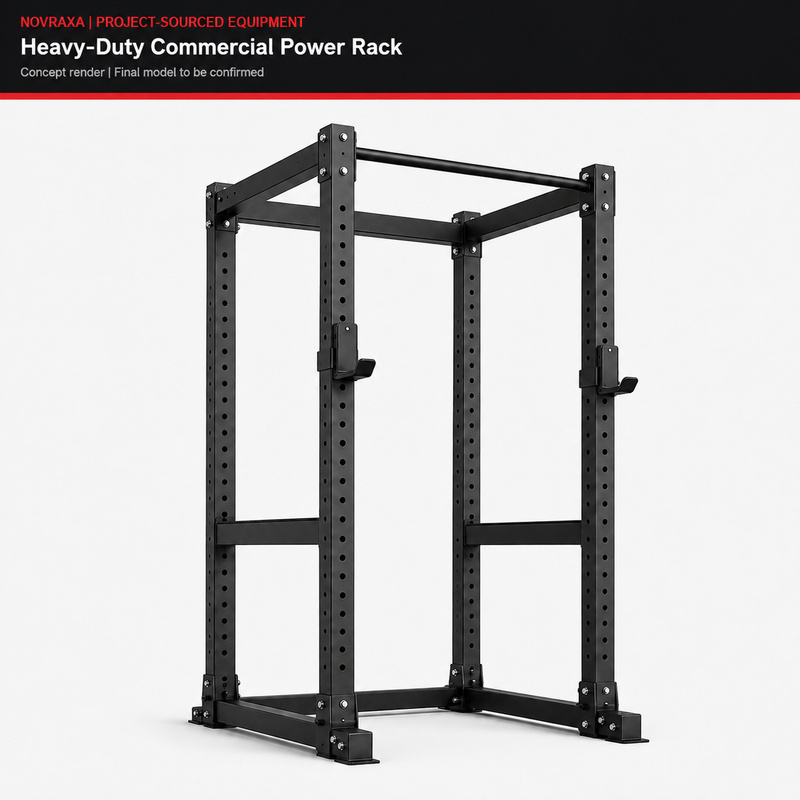
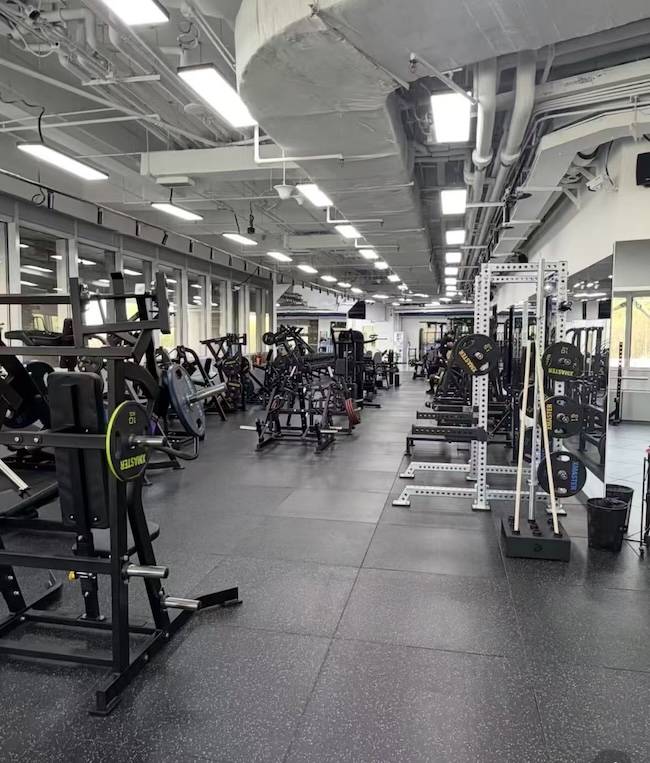
A power rack is usually a four-post structure with a training area inside the frame. It can support squats, bench presses, rack pulls, pull-ups, and other barbell movements. Add the right safety system and attachments, and it becomes a very flexible training station.
A half rack is more open. It can cover many of the same basic barbell exercises while creating a different training layout and footprint.
A simpler squat rack or squat stand may be enough when the main requirement is basic squatting and pressing, especially when floor space or budget is limited.
But here's where buyers can get into trouble.
Imagine a medium-sized commercial gym ordering four large power racks.
Why four?
Because they look professional. They're versatile. And when you see them in a catalogue, more racks can feel like a better strength area.
Then you put them on the actual floor plan.
Each rack needs more than its own footprint. You need room for a full-length barbell. Room for loading plates. Room for spotting. Room for people walking behind the station.
Suddenly, the free-weight area feels much smaller than expected.
The racks aren't the problem.
The problem is that the equipment was chosen before the training flow was considered.
For a strength-focused gym, several full power racks may make perfect sense.
For a hotel gym serving general guests, four large power racks probably don't.
For a commercial gym with mixed members, a combination of rack types and other strength stations may make more sense than simply repeating the same rack.
Before choosing a rack, answer four questions:
Who will use it?
What exercises will they perform?
How many people may need it during peak hours?
How much usable floor space do you have around it?
Don't buy the biggest rack simply because it contains more steel.
Buy the rack that matches the way your members will actually train.
2. Benches Look Simple—Until You Buy the Wrong Mix
Benches are probably one of the easiest pieces of gym equipment to underestimate.
A buyer opens a catalogue and sees:
Flat Bench
Adjustable Bench
Olympic Bench
Utility Bench
And thinks:
“They're all benches. How complicated can this be?”
Quite complicated, actually.
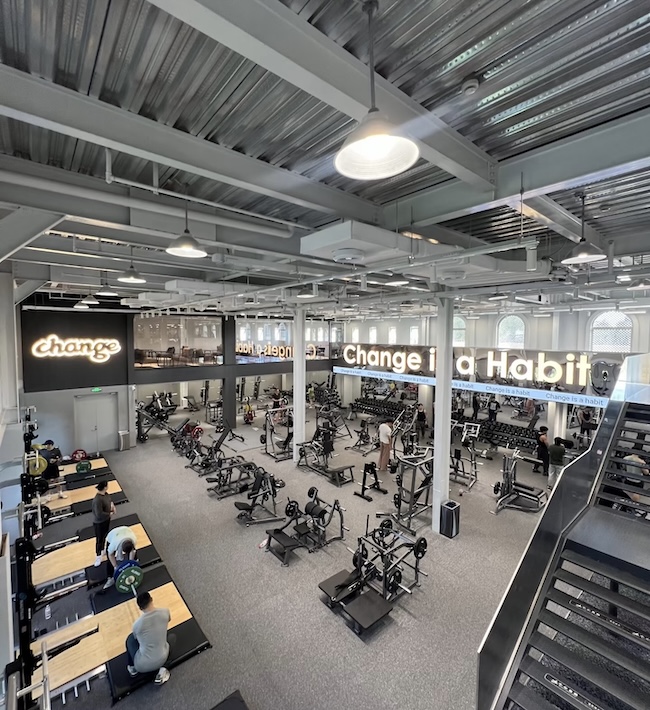
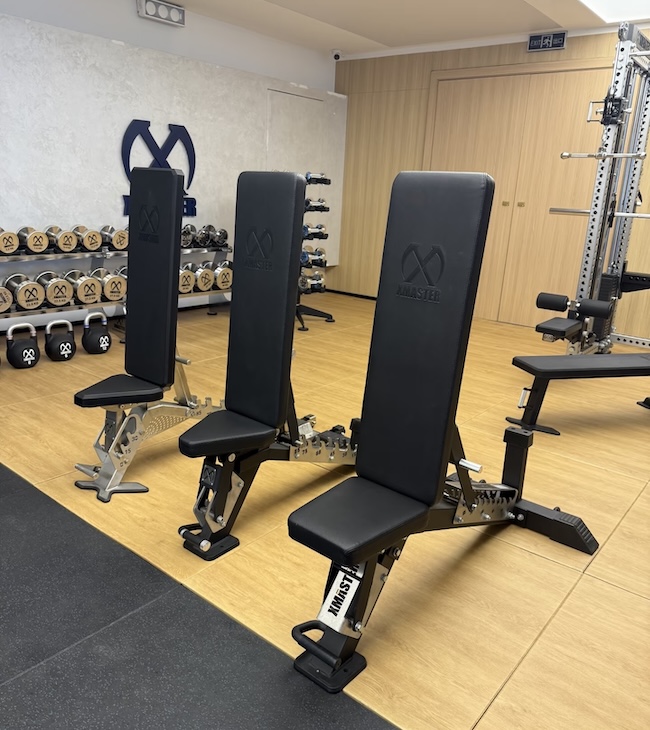
A flat bench is simple and stable. It works well for dumbbell exercises and can also be paired with the right rack for barbell bench pressing.
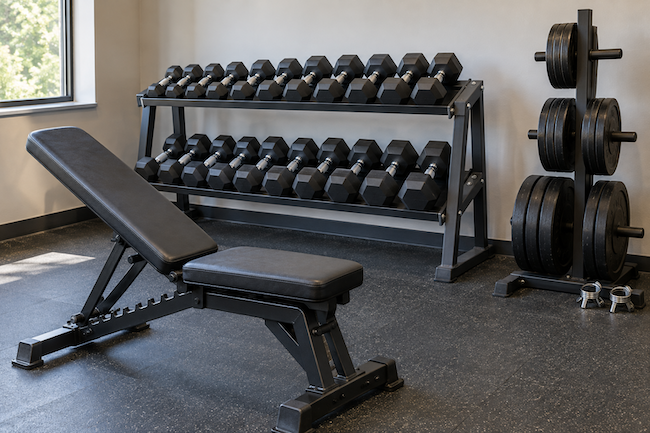
An adjustable bench gives you multiple positions—typically flat, incline, and more upright settings. That makes it useful for dumbbell presses, shoulder presses, rows, and other exercises.
A dedicated Olympic bench combines a bench with bar supports for specific barbell pressing movements.
Now imagine a hotel fitness room with roughly 100–150 square meters of total training space.
The buyer orders:
one flat bench,
one incline bench,
one Olympic bench,
and one adjustable bench.
Why?
Because they're four different products in the catalogue.
But once they arrive, the room feels crowded.
For many hotel gyms, two good adjustable benches paired with dumbbells and an appropriate rack may cover more practical training needs than several dedicated bench designs.
Now change the situation.
Put those same two adjustable benches in a busy commercial gym with hundreds of active members.
At 7 p.m., one person is doing incline dumbbell presses.
Another wants seated shoulder presses.
A third wants to move a bench into the rack.
Now two benches don't feel like enough.
This is why the right bench mix depends on traffic as much as exercise variety.
A better way to calculate benches
Don't start by asking:
“How many different bench models should I buy?”
Ask:
“How many people may need a bench at the same time?”
For a smaller hotel gym, flexibility often matters more.
For a larger commercial gym, duplicating heavily used equipment can be more useful than adding another specialized bench that rarely gets used.
That's a very different way of building an equipment list.
3. A Barbell Is Not Just a Barbell
This is another detail first-time buyers often overlook.
They spend days comparing large machines.
Frame thickness.
Upholstery.
Weight stacks.
Paint finish.
Then we get to barbells and suddenly the conversation becomes:
“Just give me some standard bars.”
But which bars?
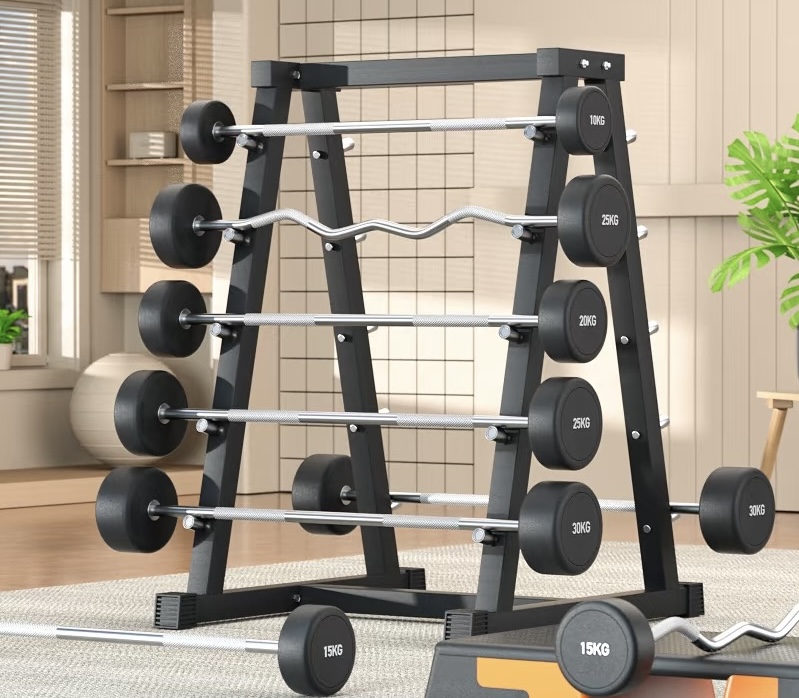
A general-purpose commercial barbell may handle most basic squats, presses, rows, and deadlifts.
But depending on the gym, you may also see shorter bars, curl bars, technique bars, and more specialized barbells.
Even two full-size Olympic-style barbells don't necessarily have the same specifications or feel.
You still need to look at things such as:
Bar dimensions
Sleeve design
Knurling
Load rating
Bearing or bushing system
Intended use
But there's another issue that's even easier to miss:
quantity.
Suppose you've installed three rack stations.
But you only ordered two general-purpose barbells.
During quiet hours, nobody notices.
At 7 p.m., one bar is being used for squats.
The second is being used for bench press.
The third rack is available.
But nobody can properly use it.
You've already paid for the rack.
You've paid for the flooring.
You've paid for the plates.
And you've given the station valuable floor space.
Yet one missing bar has turned an expensive training station into steel furniture.
Calculate barbells from simultaneous use
Don't treat barbells as cheap accessories added at the end of a quotation.
Look at how many training stations can operate at the same time.
Then make sure your barbell quantity supports them.
After that, add specialty bars only when your members and training concept actually need them.
More bar types don't automatically make a gym better.
The right bars, in the right places, do.
4. Storage Is Not an Accessory
Storage may be the least exciting part of a gym equipment quotation.
It's also one of the easiest things to regret cutting.
Plate trees.
Bar holders.
Dumbbell racks.
Kettlebell racks.
Wall-mounted storage.
Integrated rack storage.
When buyers need to reduce the budget, storage sometimes becomes one of the first things they remove.
I understand why.
A plate tree doesn't help you squat.
A bar holder doesn't build muscle.
So storage feels optional.
Until the gym opens.
Imagine a free-weight area with 300–500 kg or more of plates in daily use.
If there isn't a clear place for them, where do they go?
Against the rack.
On the floor.
Next to the bench.
Wherever the last person left them.
Now members waste time looking for matching plates.
Staff keep reorganizing the same area.
Walkways slowly become storage areas.
This isn't just about making the gym look tidy.
It's about training flow, floor usage, staff workload, safety, and everyday user experience.
The same applies to dumbbells.
You can buy a beautiful commercial dumbbell set, but if the rack doesn't provide enough practical storage, the area becomes messy very quickly.
Give every piece of equipment a “home”
When calculating plates, dumbbells, kettlebells, and bars, calculate their storage at the same time.
Ask:
Where does this bar go when nobody is using it?
Where do the 20 kg plates go?
Can a member return a dumbbell without walking across the entire free-weight area?
Can staff quickly see when something is out of place?
A well-planned gym gives almost every movable piece of equipment a clear home.
That sounds like a small detail.
After six months of daily operation, it doesn't feel small anymore.
5. Don't Buy Products One by One. Buy the Free-Weight Area as a System.
This may be the most important point in the whole article.
Let's say a supplier sends you this quotation:
4 racks
6 benches
10 barbells
1 dumbbell set
600 kg of plates
3 storage units
Look at each line individually and everything may seem reasonable.
But that's not enough.
Put the whole order together.
Can all four racks operate at the same time?
Are there enough barbells?
Are enough plates available near each station?
Can benches move safely between stations?
Does your storage block a walkway?
Are you buying a dedicated bench that repeats a function already covered by your adjustable benches?
And here's the question I think every commercial gym buyer should ask:
What happens at 7 p.m.?
That's the real test.
A gym isn't a showroom.
People move.
Benches move.
Bars move.
Plates move.
Members wait.
Staff clean.
Everyone needs room around the equipment.
Let's say your free-weight area is around 150 square meters.
Filling every available square meter with equipment may give you a longer equipment list.
It doesn't necessarily give you a better gym.
Sometimes, removing one unnecessary station improves the circulation around five other stations.
Try this before confirming your order
Take your floor plan.
Place every rack, bench, dumbbell rack, and storage unit on it.
Then imagine five members entering the free-weight area at the same time.
One wants to squat.
One wants to bench.
One wants dumbbells.
One wants to deadlift.
One is changing plates.
Now follow those five people around the room.
If they constantly cross each other's training zones, the problem may not be your floor size.
The equipment plan probably needs another look.
6. What Should Different Buyers Actually Prioritize?
There is no perfect free-weight package for every project.
A hotel gym and a serious commercial gym shouldn't automatically receive the same equipment list.
And a dealer buying inventory has a completely different problem again.
Here's a simple way to think about it:
Buyer Type | Main Priority | What Usually Matters More | Common Mistake | Question to Ask |
Hotel Fitness Room | Simplicity and ease of use | Dumbbells, adjustable benches, compact rack solution, practical barbells/plates, clean storage | Too many specialized strength stations | Can an ordinary hotel guest understand and use this area easily? |
Commercial Gym | Peak-hour capacity | Multiple useful training stations, enough benches and barbells, well-distributed plates and storage | Buying variety without enough capacity | Will this setup still work at 7 p.m.? |
Strength-Focused Gym | Strength training capacity | More racks, platforms, barbells, plates and appropriate specialty equipment | Spending heavily on racks but underbuying bars or plates | How many members can train simultaneously? |
Dealer / Distributor | Flexible product coverage | Products and combinations that can serve different project types | Stocking too many products with overlapping functions | Can this range serve hotel, commercial and strength projects? |
This is also why copying somebody else's equipment list can be risky.
A hotel fitness room usually benefits from simplicity.
A commercial gym needs to think harder about peak-hour traffic.
A strength-focused facility may need far more rack, barbell, plate, and platform capacity.
A dealer needs a product range that can adapt to different projects without stocking five products that solve almost the same problem.
The equipment names may be the same.
The buying logic isn't.
Don't Build a Longer Equipment List. Build a Better Gym.
Racks, benches, barbells, plates, and storage don't look complicated when you see them individually.
The challenge begins when they all have to work together.
The rack determines where people train.
The bench changes what they can do there.
The barbell determines whether the station can actually operate.
The plates determine how people load it.
And storage determines whether the whole area still works when twenty people start moving everything around.
So when you're building your next equipment list, don't only ask:
“What equipment am I missing?”
Ask:
“What training function am I missing?”
Those are not the same question.
At Novraxa, this is how we prefer to look at commercial gym projects.
Different manufacturers can be strong in different product categories. One factory may make excellent racks and strength machines. Another may be stronger in cardio equipment. Another may have better solutions for a particular project or price level.
Our role as a fitness equipment supply-chain partner isn't simply to put more machines into a container.
We want to understand the project first.
What kind of facility are you building?
How large is it?
Who will use it?
Which equipment do you already plan to buy?
Which functions are missing?
Which ones are being repeated?
Then we can help match equipment and manufacturers, coordinate specifications and finishes, check the equipment before shipment, and look at how the complete order fits together.
Because a successful gym project shouldn't start with filling a container.
It should start with understanding the gym you want to build.
If you're planning a commercial gym, hotel fitness room, company gym, or distribution project, send Novraxa your:
facility type, floor size, target users, equipment list, and destination country.
We'll start with the project itself and look at what you actually need—and what you probably don't.
And if you're not ready to buy yet, that's fine too.
Keep following Novraxa.
We'll keep talking about commercial gym equipment from the buyer's side—not just what each machine is called, but whether it actually deserves a place in your gym.
FAQ
What free-weight equipment does a commercial gym need?
There is no single equipment list that fits every commercial gym. Start with member profile, floor space and peak-hour capacity. Racks, benches, barbells, dumbbells, plates and storage should be planned as one system rather than as separate purchases.
Should I buy a power rack, half rack, or squat rack?
Start with how the station will be used. Consider the exercises, available floor space, member profile and expected peak-hour demand before choosing the rack type.
How many barbells should a commercial gym have?
Calculate barbell quantity based on simultaneous training capacity. If three rack stations may operate at the same time, your barbell plan needs to support that rather than simply adding a few bars at the end of the order.
Are adjustable benches better for hotel gyms?
For many smaller hotel fitness rooms, adjustable benches can provide useful flexibility without requiring several dedicated bench types. The final quantity and configuration should still depend on floor space and expected usage.
Is gym equipment storage really necessary?
Yes. Storage affects much more than appearance. Proper storage for plates, barbells, dumbbells and kettlebells helps improve training flow, usable floor space, staff efficiency and the overall member experience.