Welcome to NOVRAXA Fitness Equipment


Complete Gym Equipment List: What’s Missing After the Machines Arrive?
Every machine on your quotation can arrive, and your gym can still be unfinished. The cable station has the wrong attachments. The barbells have no compatible collars. Plates sit against a wall because nobody ordered storage. Your delivery photographs look impressive. Your opening checklist tells a different story.
Imagine this illustrative hotel handover in Jeddah. The manager walks past new treadmills and eight strength machines. “Can we open tomorrow?” she asks. The installer points to a stack of plates. “Who ordered the storage?” Someone opens an accessory box beside the cable station. One handle. The purchase order says “complete gym equipment package,” but nobody agreed on what “complete” included.
This guide explains what a complete gym equipment list should include beyond the machines—and how to choose what your facility needs. We will connect attachments, weights, storage, flooring, installation, maintenance, and documents to the way people use the room. Whether you own a commercial gym, purchase for a hotel, distribute equipment, or source from China, the goal is a space that works after delivery.
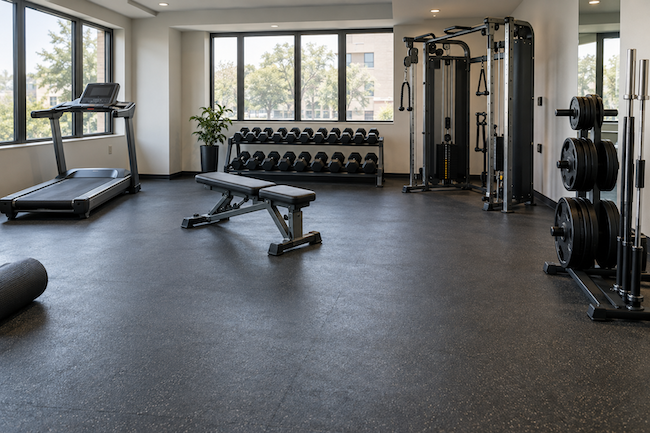
A complete gym equipment list covers the machines, supporting items, services, and information needed to provide the intended training experience.
It does not require buying everything from one supplier. It requires a clear specification, quantity, and purchasing responsibility for every necessary item.
Beyond the machines | What to establish before ordering |
Attachments | Exercises supported, compatibility, quantities, and inclusions |
Weights and benches | Useful weight combinations and independent training capacity |
Storage | What fits, where it goes, and how users access it |
Flooring and space | Activity requirements, operating areas, and circulation |
Installation | Responsibility for unloading, movement, assembly, and checks |
Maintenance supplies | Model-specific care, service arrangements, and compatible parts |
Handover documents | Approved specifications, manuals, warranty terms, and asset records |
1. Attachments: Buy the Exercises You Intend to Offer
A cable station does not deliver every advertised exercise simply because it has two pulleys.
The practical options depend on the selected configuration and attachments.
Short handles, long bars, ropes, and ankle straps support different setups. Some overlap. Others are necessary for the activities you plan.
Start with those activities.
For two-handed cable fly movements, confirm an appropriate pair of handles. For pushdowns, specify the attachment. For lower-body cable exercises, discuss the required strap, connection, and setup.
A documented example appears in the Life Fitness Dual Adjustable Pulley specifications. The listed package includes two short strap handles and two long strap handles, alongside a triceps rope, ankle strap, long bar, and other accessories.
That defines one package. It does not establish what another supplier includes with a similarly named machine.
Now consider an illustrative commercial gym with two cable stations but only one frequently requested rope attachment. Users can still end up waiting.
A quieter hotel might benefit more from a smaller, clearly labelled selection than from multiple attachments guests cannot identify.
Turn “Accessories Included” Into an Itemized List
For each attachment, record:
Name and photograph.
Quantity.
Compatible machine or connection.
Intended exercise.
Whether it is included or separately priced.
Storage position.
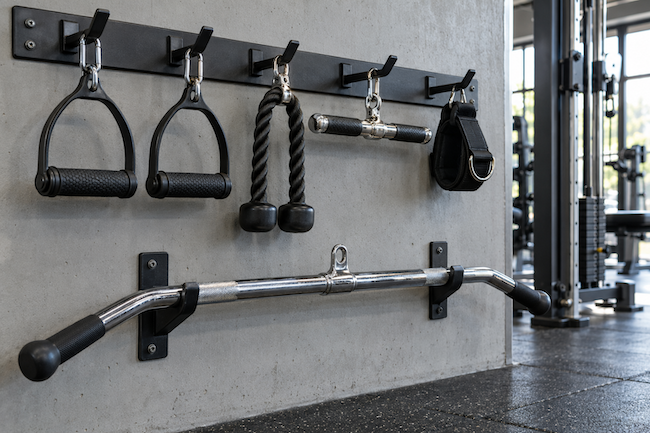
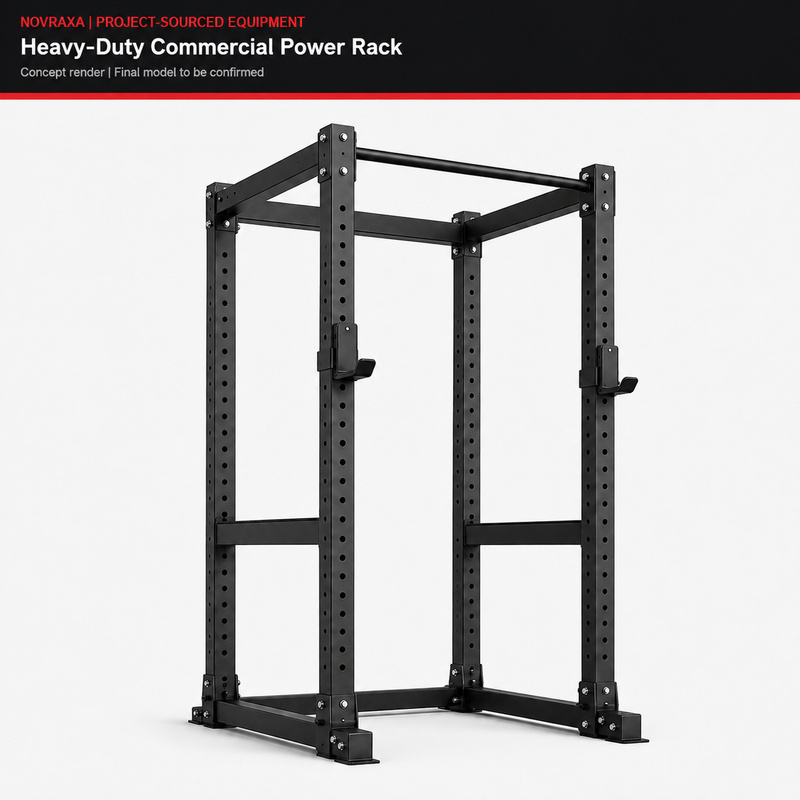
Apply the same approach to rack accessories. J-hooks, safety components, pull-up options, and plate storage must match the selected frame.
NOVRAXA’s power-rack sourcing information identifies these points for confirmation against the factory model.
Before approving the order, request a demonstration of your priority exercises using the quoted configuration.
An accessory photograph is useful. A written list makes the agreement easier to inspect at receipt.
Ask about duplicate functions, too. Two handles may look different while supporting similar exercises. Buy the second because it adds a useful option or capacity—not simply because it appears in the catalogue.
2. Weights, Benches, and Storage: Count Complete Training Positions
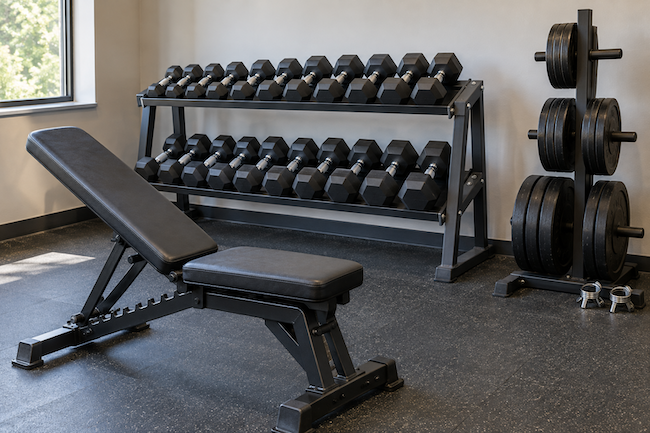
A rack, barbell, bench, plates, and collars can form one working arrangement. Listing the rack alone does not make that arrangement complete.
I would begin with the number of people expected to train independently during busy periods.
Then work backward to the supporting items.
In an illustrative two-barbell area, both users need access to compatible collars and useful plate combinations. A large total plate weight does not guarantee they can each load what they need.
List plate sizes and quantities separately. Confirm whether dumbbells are quoted as individual pieces, pairs, or complete sets.
A ten-pair set contains twenty dumbbells. Ten individual dumbbells are a different purchase.
Storage needs the same precision.
The Life Fitness Two Tier Dumbbell Rack is described as holding ten pairs. You still need to confirm compatibility with the shapes, dimensions, and weights of your selected dumbbells.
A rack’s stated pair capacity does not make it suitable for every dumbbell set.
Storage type | What to confirm |
Dumbbell rack | Pair capacity, cradle or shelf design, dumbbell fit |
Plate tree | Compatible plate openings, usable positions, access |
Integrated rack storage | Compatibility and interference with exercises |
Barbell holder | Bar fit, orientation, access, installation |
Accessory storage | Space for handles, ropes, straps, and smaller items |
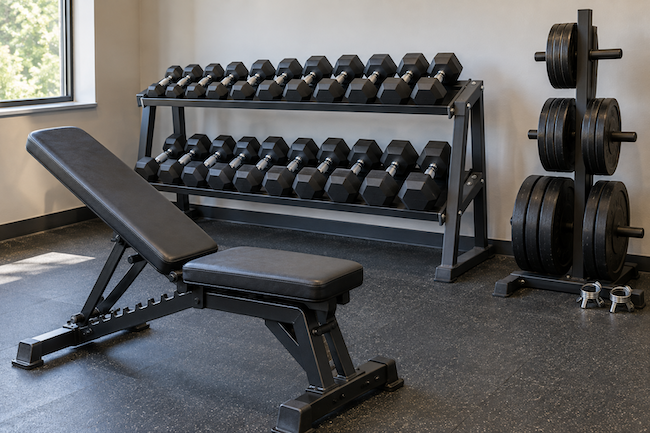
Benches deserve a function review.
A flat bench and an adjustable bench overlap in some exercises but offer different positions. Two benches covering similar movements may still be justified by demand.
Ask what each additional bench contributes: another angle, another location, or capacity during peak periods.
For hotels, a manageable weight range with clear storage may serve guests better than a larger collection. Commercial gyms may need duplicate popular weights and more bench positions.
At NOVRAXA, coordinating specifications across manufacturers helps when racks, benches, bars, and plates come from different sources.
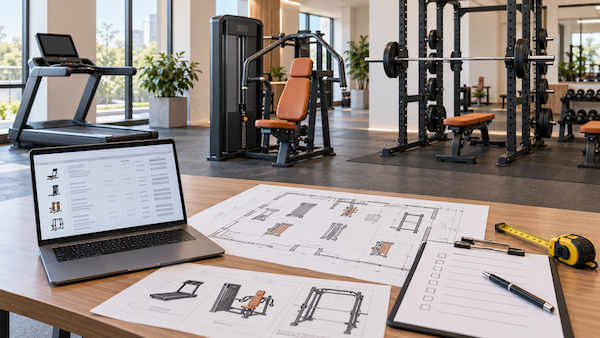
Draw each complete training position before ordering. Include the supporting items and their storage. That drawing often reveals omissions a product list hides.
3. Flooring and Space: Plan for People, Not Just Machine Footprints
Equipment can fit on a drawing while leaving too little room to use it.
People need space to get on and off, adjust seats, move handles, load plates, and carry weights. Staff need access for cleaning and maintenance.
The Concept2 RowErg specifications provide a clear example. The assembled machine measures approximately 244 × 61 cm, while the recommended area with clearance for use is 274 × 122 cm.
Calculated from those published dimensions, the footprint is about 1.49 m². The recommended area with clearance is about 3.34 m².
That is a meaningful difference in a compact room. Use the selected model’s requirements when planning your layout.
Flooring also needs an activity-based decision.
An exercise mat, equipment mat, rubber flooring system, and lifting platform serve different purposes:
An exercise mat supports floor-based movement.
An equipment mat sits beneath a machine where appropriate.
A flooring system covers a designated training area.
A lifting platform supports a particular training use and installation.
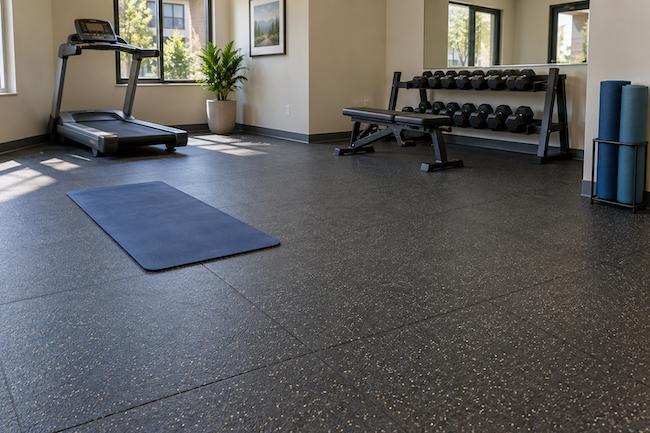
Select the surface according to activities, equipment, substrate, building conditions, cleaning needs, and manufacturer guidance.
For upstairs facilities, have qualified project professionals assess structural and vibration requirements. Flooring selection is only one part of that review.
Watch How the Room Will Work
For an existing facility, observe several genuine peak periods. Note occupied stations, waiting users, and the routes people take.
For a new project, discuss expected users and operating arrangements with the owner or hotel team.
Mark machine operating zones, free-weight positions, plate-loading access, circulation, storage, stretching space, and maintenance access.
Coordinate mirrors, ventilation, lighting, drinking-water access, and required safety arrangements with the facility team.
These belong in the project plan even when purchased locally.
In a hotel gym, useful open space may support stretching, mobility work, and floor exercises better than another machine with overlapping functions.
Give each area a purpose before filling it.
4. Delivery and Installation: Define Where the Supplier’s Work Ends
“Delivered” can mean the port, the loading bay, the building entrance, or the final fitness room.
Those are different services.
Unloading, internal movement, assembly, installation, electrical connection, and commissioning need assigned responsibilities.
A useful product example is the Concept2 SkiErg floor stand. It provides an alternative to wall mounting. The manufacturer lists the stand-equipped arrangement at approximately 60 × 127 × 216 cm and states that the SkiErg itself is sold separately from that stand listing.
The machine and its support arrangement are distinct purchasing items.
For a wall-mounted configuration, confirm wall suitability, fixing requirements, permissions, and installation responsibility. For a freestanding arrangement, include the correct stand.
A machine waiting for its mounting arrangement has arrived, but it is not ready for use.
For larger equipment, confirm packed and assembled dimensions, weights, doorways, access routes, lift capacity where relevant, and assembly requirements.
For powered machines, the building team should confirm the actual electrical provision at the installation point. Obtain the supplier’s requirements for the selected model.
Task | What needs agreement |
Unloading | Personnel, equipment, delivery point |
Internal movement | Route, restrictions, protective measures |
Assembly | Installer, tools, instructions, labour scope |
Fixing or anchoring | Manufacturer requirements and site suitability |
Electrical work | Qualified responsibility and confirmed requirements |
Commissioning | Checks, demonstrations, acceptance records |
Packaging removal | Responsibility for crates and protective materials |
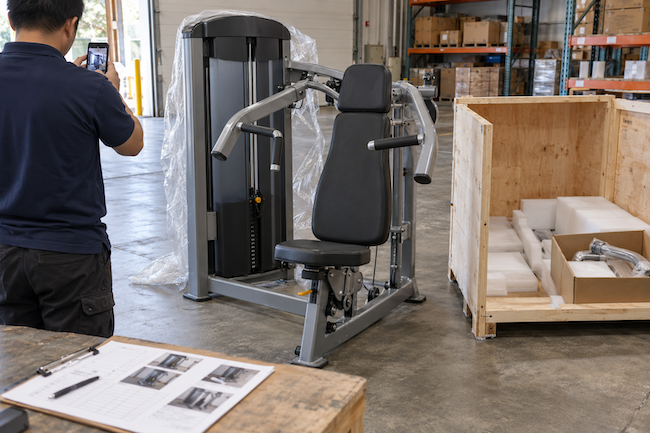
For buyers sourcing from China, compare quotations using the same delivery scope.
Consolidating suitable items may help shipment planning. Ask for the actual effects on packing, weight, handling, and freight before deciding what to combine.
NOVRAXA supports manufacturer coordination and shipment preparation. Agree which tasks are included and which belong to local contractors or the operator.
Record outstanding issues at handover and assign someone to resolve each one.
The opening team should know what remains, who owns it, and when it will be completed.
5. Maintenance and Daily Supplies: Prepare for the First Fault Report
The opening list should support the first month of operation as well as the first day.
Cleaning materials, maintenance instructions, service arrangements, and compatible parts determine whether staff can keep the room usable.
A documented example comes from Concept2’s BikeErg maintenance instructions. They specify checks every 250 hours of use, including inspection of six fasteners on the crank arms and pedals.
That is a model-specific requirement.
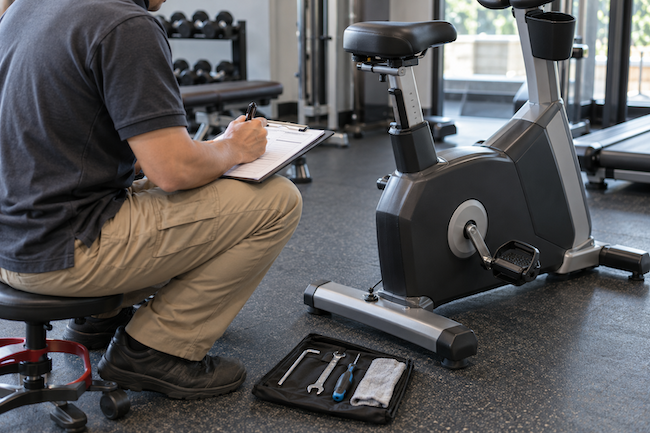
Obtain the correct instructions for each selected product. Ask who will do the work, which tools are required, and how service activity will be recorded.
Cleaning needs similar care. Life Fitness publishes equipment-cleaning guidance, showing why products and methods should follow equipment-specific recommendations.
Screens, grips, coatings, and upholstery may need different treatment.
Build an Operating-Supplies List
Consider:
Compatible cleaning products and suitable cloths.
Cleaning stations, bins, and replenishment.
Towels and collection arrangements, if offered.
Approved tools for assigned maintenance.
Model-specific lubricants, where required.
Supplier-recommended initial spares.
Service contacts and a parts-ordering process.
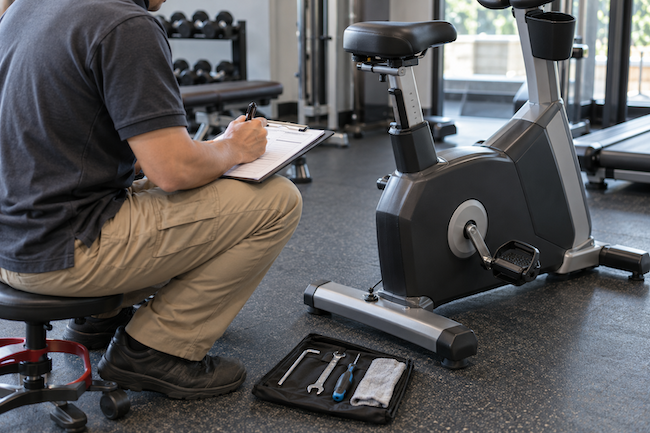
Ask the supplier to explain the purpose and compatibility of a proposed spare-parts kit.
A belt that does not fit your treadmill is not useful stock. Parts also need someone who can diagnose the issue and install the correct replacement.
Before buying cardio equipment, ask:
What use is the selected model intended for?
Which parts may require replacement?
How are compatible parts identified?
Who provides service at the destination?
What do warranty and service terms cover?
What lead times should the operator plan around?
Match the support plan to your models, expected demand, service capability, and destination.
For hotels, assign maintenance to the engineering team, a service provider, or another agreed party. For distributors, prepare the information customers will need when requesting help.
Keep each machine’s identity, manual, and service history connected. A clear fault report helps everyone find the right unit and discuss the next step.
6. Documents and Purchasing Responsibilities: Make “Complete” Measurable
The handover is incomplete if staff cannot find instructions, identify parts, or understand the warranty.
A product name and invoice cannot answer all those questions.
Consider Concept2’s product warranty information. It describes a limited two-year and five-year warranty for its RowErgs, SkiErgs, and BikeErgs, with details in the applicable documents.
A headline warranty period leaves important questions open.
Request the terms that apply to your purchase and destination. Confirm coverage, exclusions, claims procedures, and responsibility for parts, labour, travel, or shipping.
Request an Organized Handover Folder
Document | Purpose |
Approved equipment schedule | Models, quantities, configurations |
Accessory list | Items accompanying each machine |
Packing list | Packages, equipment, attachments |
Assembly instructions | Correct assembly and installation |
Operating manuals | Adjustments, settings, intended use |
Maintenance instructions | Model-specific care |
Warranty documents | Applicable support terms |
Parts references | Compatible replacement identification |
Inspection and acceptance records | Checks and outstanding issues |
Asset records | Individual units and their documents |
For Middle East projects, agree on the English and Arabic instructions or labels needed for users, operators, and applicable local requirements.
For imports, coordinate descriptions, packing information, and required documents with the importer and customs broker. Product classification and conformity requirements depend on the goods and destination.
Give Every Purchasing Line an Owner
Use a working sheet like this. The responsibilities below are examples to confirm for your project.
Item | Specification or quantity basis | Status to record | Responsibility to assign |
Cable attachments | Approved model and planned exercises | Included or separately quoted | Equipment supplier |
Dumbbell storage | Confirmed set and compatible rack | Quoted or awaiting confirmation | Buyer and supplier |
Flooring | Approved activity zones and site specification | Local or equipment-order supply | Buyer and flooring contractor |
Electrical provision | Selected models and approved layout | Site preparation required | Building team |
Assembly | Equipment-specific requirements | Included or separately arranged | Supplier or local installer |
Handover documents | All selected models and individual units | Required before acceptance | Supplier and operator |
Add a responsible person and confirmation deadline to unresolved lines.
Then compare the total project scope: equipment, accessories, freight, local movement, installation, site preparation, and operating supplies.
NOVRAXA’s sourcing approach covers equipment matching, manufacturer coordination, specification consistency, quality checking, and shipment preparation.
Clear purchasing records give those activities a shared reference across a mixed-equipment project.
The useful question is straightforward: can everyone explain what is included, what remains outside the quotation, and who will supply it?
Build a Gym That Is Ready for People
Machines are the most visible purchase. A usable gym depends on the details around them.
Attachments enable exercises. Compatible weights and benches complete training positions. Storage keeps items accessible. Flooring and layout support movement. Installation, supplies, and documents connect delivery to everyday use.
The right combination will differ between a hotel, commercial gym, and distributor’s project.
Choose each item for a clear purpose, with an agreed specification and someone responsible for supplying it.
Users may never notice the work behind that list. They will notice whether a bench is available, the right attachment is easy to find, and the room lets them finish their workout.
Send NOVRAXA your machine shortlist, floor plan, facility type, expected users, and destination country through the official website.
Ask us to review supporting equipment, potential function overlap, configuration details, and shipment information. Confirm local facility and installation responsibilities alongside the order.
If your project is still taking shape, keep following NOVRAXA’s equipment selection and sourcing guides.
A complete gym is ready for more than delivery photographs.
It is ready for the people who walk through the door.