Welcome to NOVRAXA Fitness Equipment


Gym Equipment Terminology for Importers: The Name Looks Right. Is the Machine Wrong?
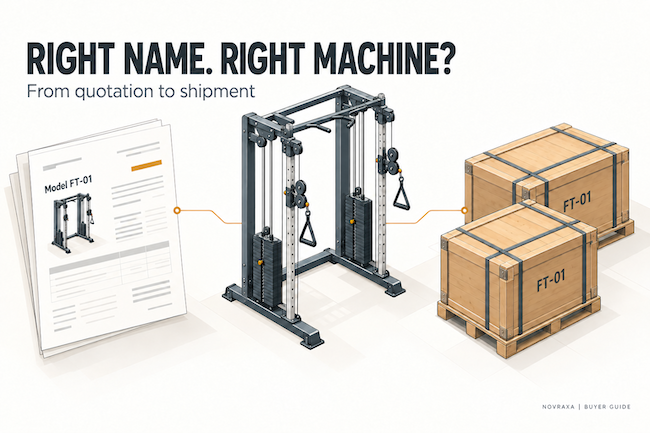
You can recognize every name on a gym equipment quotation and still buy the wrong machines. “Chest press” does not identify the loading system. “Functional trainer” does not tell you the resistance at the handle. And “fitness equipment” on an invoice does not explain which machine you approved. Familiar words can hide expensive differences.
Imagine this buying situation. A hotel procurement manager in Dubai has three quotations beside a floor plan. One lists a “functional trainer,” another a “dual adjustable pulley,” and another a “cable crossover.” He messages a supplier: “Are these the same?” The answer comes back: “Similar functions.” He looks again. One machine is wider. Another has fixed outlets. “Then which one actually fits our gym?” That question is where useful procurement advice begins.
This guide explains gym equipment terminology for importers through the decisions behind the names. We will cover what to buy, what to compare, which functions overlap, and how to connect the approved equipment with its shipping descriptions. If you are importing gym equipment from China for a commercial gym, hotel, or distribution business, I want you to finish with a clearer order—not a longer vocabulary.
1. Separate the Product Name, Technical Specification, and Shipping Description
The product name tells you what to investigate. The specification tells you what to approve. The shipping description identifies the goods being transported.
These descriptions should connect, but they do different jobs.
Consider the following example. “CP-01” is a fictional model code used only to illustrate the relationship.
Information layer | Example | What it helps you establish |
Marketing name | Commercial Strength Series | Product positioning or collection |
Product name | Selectorized seated chest press | Machine category and loading method |
Technical specification | Model CP-01; independent arms; confirmed stack, dimensions, and accessories | Exact configuration being purchased |
Shipping description | Non-powered selectorized chest press exercise machine, model CP-01, supplied disassembled | Identity and condition of the shipped goods |
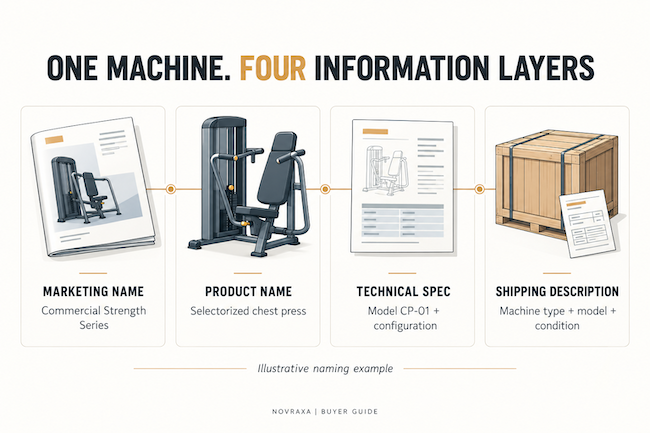
The final shipping wording must suit the actual goods and destination requirements. The example is a starting point for discussion with your supplier and broker.
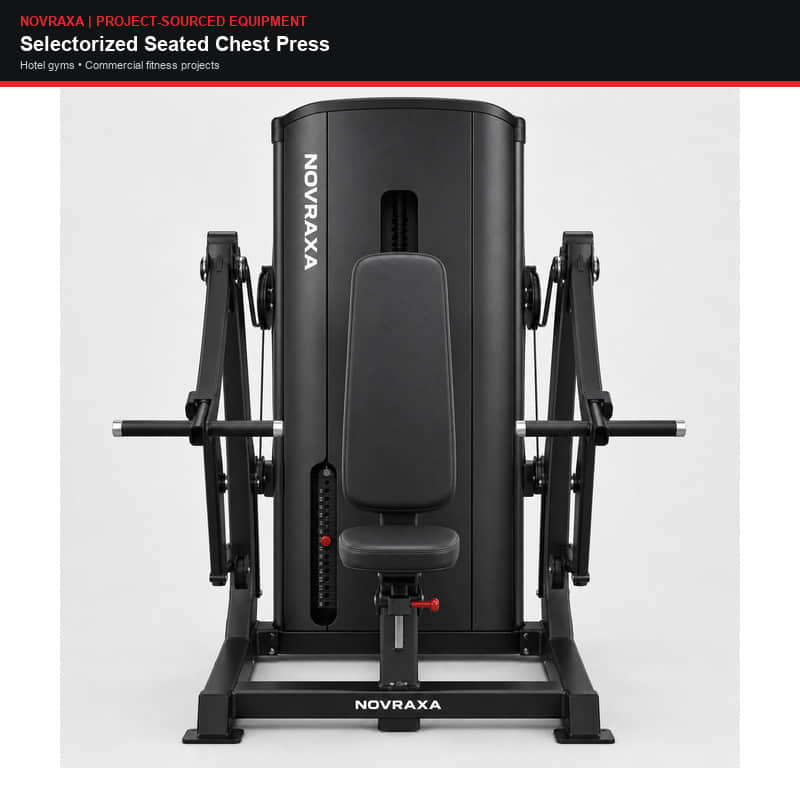
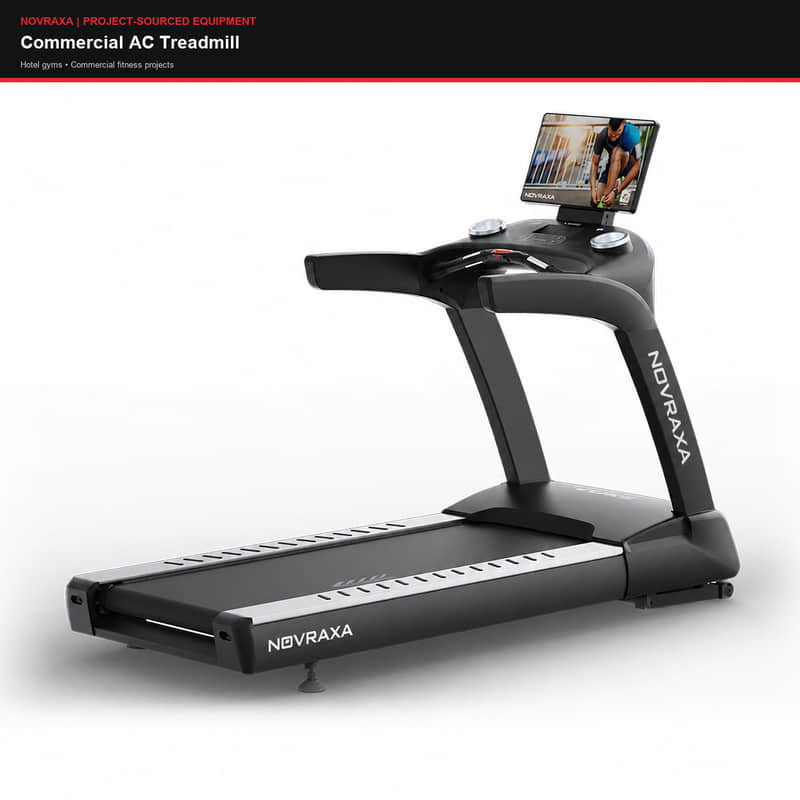
You can see useful descriptive naming on Novraxa’s website, which lists a Commercial AC Treadmill and a Selectorized Seated Chest Press Machine. Those two names already communicate more than “cardio equipment” and “strength machine.”
But they still leave questions.
“AC treadmill” does not establish voltage, frequency, circuit requirements, or permitted operating conditions. “Selectorized chest press” does not establish the weight increments, adjustment range, or movement of the arms.
This distinction matters when comparing selectorized and plate-loaded equipment:
Selectorized: resistance comes from a built-in stack or selection system.
Plate-loaded: users add separate weight plates.
Independent arms: the arms can move separately.
Converging arms: the arms move toward each other during the press.
The last two describe movement, rather than how resistance is loaded. A selectorized machine can have independent, converging arms.
For a hotel gym, quick resistance changes may be valuable. For a strength-focused club, members may prefer particular plate-loaded movements. Neither category automatically proves better quality.
Before comparing prices, request the model code, current photographs, movement video, loading system, dimensions, included accessories, and warranty scope.
Then record your approved configuration in writing.
A lower price only becomes meaningful once you know what is included.
2. Functional Trainer vs. Cable Crossover: Compare the System Behind the Label
Cable machines with similar names can deliver different training experiences.
A dual adjustable pulley, often called a DAP, generally provides two height-adjustable cable outlets. A functional trainer is a broader term commonly used for versatile cable equipment. A cable crossover may describe a wider two-sided station, with fixed or adjustable outlets.
Suppliers use these terms differently. Treat them as clues, then inspect the actual configuration.
One published example shows why. The Life Fitness CMDAP Dual Adjustable Pulley specifies a 4:1 resistance level. The manufacturer also lists a separate 2:1 Dual Adjustable Pulley in the same equipment family. A familiar name clearly does not establish one universal cable ratio. Source: Life Fitness Dual Adjustable Pulley specifications.
Here is what that means for your quotation.
Suppose two machines each advertise an 80 kg stack. In an idealized system using the conventional stack-to-handle ratio, a 2:1 arrangement would provide roughly 40 kg equivalent resistance at one handle. A 4:1 arrangement would provide roughly 20 kg.
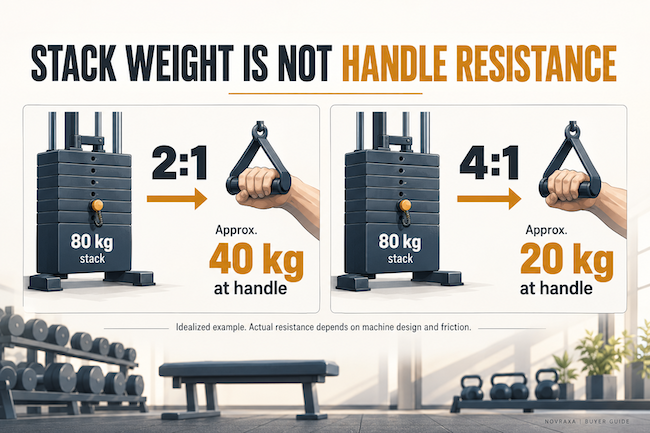
Actual resistance depends on the machine, friction, attachments, and routing. Ask the manufacturer how its ratio is defined and what resistance reaches the handle.
Do not approve a cable machine on stack weight alone.
Instead, compare:
Specification | Why it matters |
Starting resistance and increments | Whether lighter exercises are practical |
Maximum resistance at each handle | Whether heavier users have enough load |
Cable travel | Whether intended movements fit |
Outlet adjustment range | Whether users can set suitable pulling angles |
Stack independence | How resistance is shared or separated |
Included attachments | What users can actually do on arrival |
Intended simultaneous use | How many people the station can serve |
Then test your priority exercises through video or a demonstration.
For a lat pulldown, check the seat, thigh restraint, pulling position, and available resistance. An overhead cable does not automatically replace a dedicated lat pulldown station.
For a hotel, versatility may help you cover several needs in limited space. For a busy club, dedicated stations may reduce queues.
I would ask one practical question before adding another cable machine: what does this model let our users do better than the equipment already selected?
If the answer is unclear, pause that line item.
3. Smith Machine vs. Power Rack: Shared Exercises, Different Purchases
A Smith machine and a power rack can support some of the same exercises without meeting the same requirement.
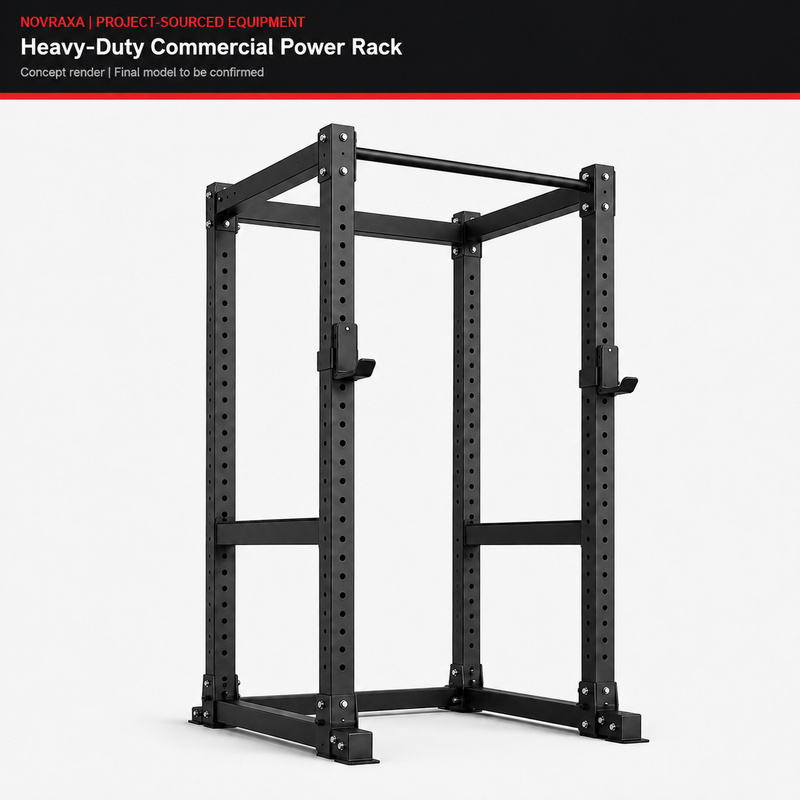
A Smith machine has a bar that moves along guides. A power rack provides a structure for free-barbell training, with supports and an appropriate safety system. Half racks and squat stands offer other arrangements, depending on their design and accessories.
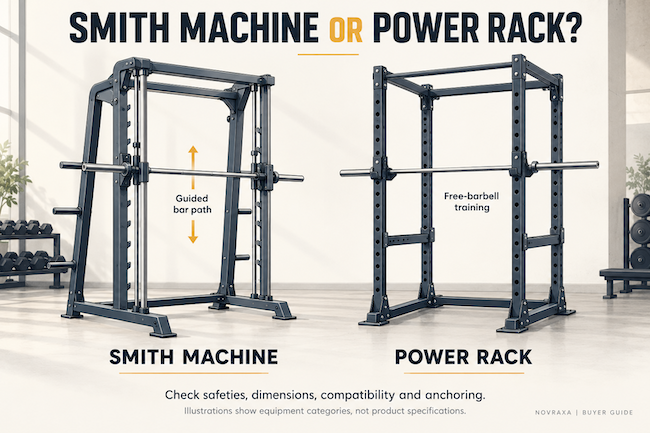
The difference becomes obvious when a member expects free-barbell squats and finds only a guided bar.
Even within the Smith machine category, specifications vary.
For example, the Life Fitness SSM lists a 7-degree bar angle and a 20 lb / 9 kg bar weight. Those are meaningful details that the name “Smith machine” does not communicate. Another model may have a different guide angle or starting resistance. Source: Life Fitness Smith Machine specifications.
For a strength-focused commercial gym, both a rack and a Smith machine may deserve space. Different members want different training experiences, and separate stations can spread demand.
For a hotel, first consider the intended users, supervision, instruction, and maintenance arrangements. A guided bar still needs suitable stops, correct adjustment, and proper use. No equipment label replaces those checks.
When ordering a rack, confirm the whole working package:
Frame model and dimensions.
J-cups and compatible safety components.
Barbell, bench, and plate compatibility.
Load ratings and their stated conditions.
Anchoring requirements.
Included attachments and storage.
Installation instructions and replacement parts.
A catalogue photograph may show equipment that is priced separately. The bench, barbell, plates, and attachments need their own confirmation.
Novraxa’s commercial power rack information specifically calls for factory confirmation of the frame section, safe working load, anchoring requirement, and attachment package before production. Those are useful questions to bring into any rack discussion.
For a combination rack, cable, and Smith system, also request a demonstration of transitions between exercises.
Where does the bench go? Which attachments must be removed? Can another person use a different function at the same time?
An all-in-one machine can be a good space-saving choice. It can also concentrate several users around one working area. Check the actual arrangement before counting its exercise functions as separate stations.
4. Audit Functional Overlap Before Adding More Machines
Repeated functions are worth buying when they serve a clear purpose. Otherwise, they consume budget and space.
A pec fly, cable crossover, and functional trainer can all support chest-focused exercises. That does not mean every gym needs all three. It also does not mean one automatically replaces the others.
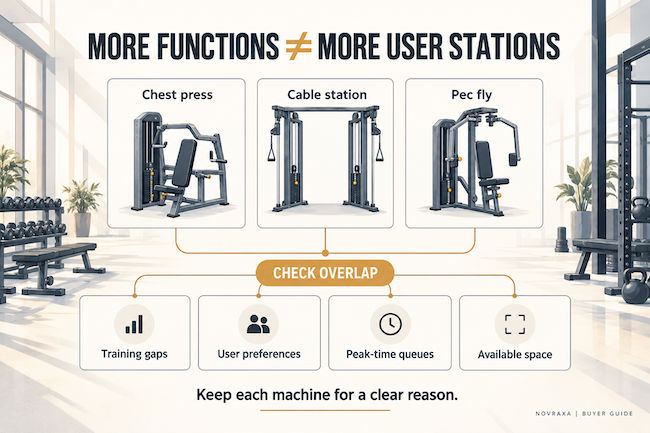
Here is a documented product example.
The Life Fitness Insignia SS-FLY combines pectoral fly and rear deltoid exercises. Its published machine dimensions are approximately 203 × 197 cm, while the listed live area is approximately 233 × 258 cm. Those rectangular areas work out to roughly 4.0 m² and 6.0 m², respectively. Source: Life Fitness Pectoral Fly/Rear Deltoid specifications.
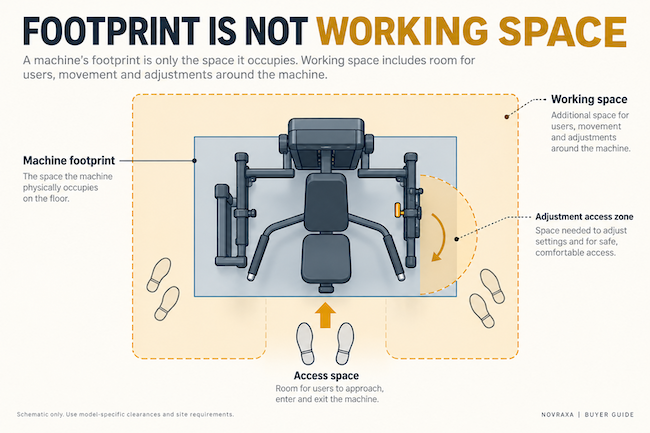
That example answers two different buying questions.
First, two exercise functions do not automatically create two independent user stations.
Second, machine footprint and working space are different measurements.
For your shortlist, build a movement map:
Training need | Possible equipment | Question before buying another |
Horizontal pressing | Chest press, bench and rack, suitable cable setup | Does it add a preferred experience or capacity? |
Chest fly | Pec fly, crossover, functional trainer | Is the dedicated station useful for this audience? |
Vertical pulling | Lat pulldown, assisted pull-up, suitable cable station | Are resistance and user support adequate? |
Horizontal pulling | Seated row, supported row, cable station | Does the support or setup add value? |
Squatting | Rack, Smith machine, hack squat | Which experience do your users expect? |
These are overlapping options, not identical substitutes.
Now add expected demand at your busiest time.
In an illustrative 70 m² hotel gym, three chest-focused stations might leave little room for lower-body training, cardio, storage, and circulation. In a large club, the same three stations might be used continuously.
The decision comes from the room and its users.
I would keep an additional machine when it does at least one of four things: fills a training gap, serves a different user, improves a specific training experience, or reduces a realistic queue.
At Novraxa, our range spans strength machines, cardio, free weights, and racks for commercial facilities. When discussing a complete gym project, bring the whole equipment list rather than isolated product names. That makes it possible to discuss how the pieces should work together.
The best question is rarely “What else can we add?”
It is “What will this room still struggle to provide?”
5. Match the Approved Machine to the Shipping Paperwork
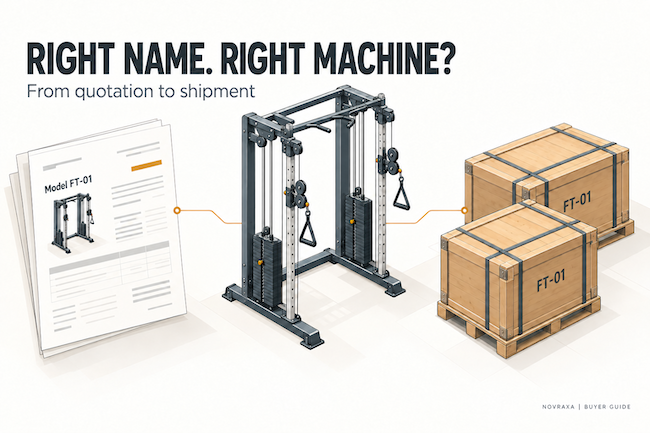
The machine you select should remain identifiable from quotation to delivery.
A commercial invoice records the goods sold and their value. A packing list identifies package contents, weights, and measurements. Transport documents have their own requirements and may use an agreed summary.
The wording does not need to be identical everywhere. It needs to be accurate, consistent, and traceable. The International Trade Administration explains these different document roles in its guide to common export documents.
Return to the SS-FLY example. Its published product weight is 321 kg. That is a machine specification, not a confirmed packed gross weight.
Before using that number for freight planning, establish how the machine will be shipped, what packaging is used, and whether components travel separately.
For any model, keep three sets of information separate:
Installed equipment: assembled dimensions, operating space, machine weight.
Packed goods: package count, package dimensions, net and gross weights.
Order identity: model, configuration, accessories, quantities, and document references.
One machine might occupy three packages. That does not make it three machines.
For illustration, one chest press could be mapped to packages 001–003, containing the frame, stack components, and guards or hardware. Your supplier’s actual packing plan determines the contents and numbering.
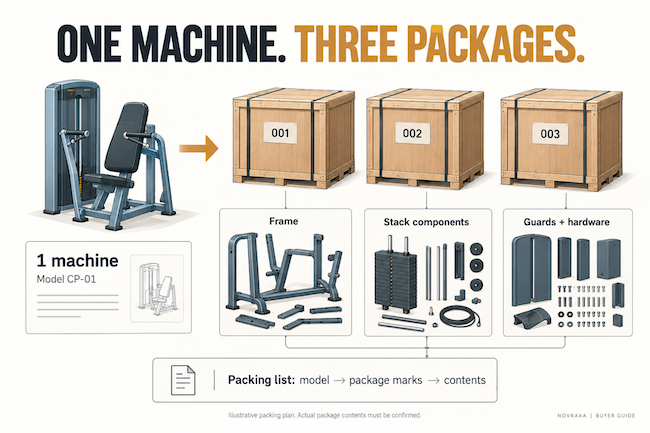
The packing list should make that relationship clear. Official packing-list guidance describes package-level contents, weights, and measurements as information used by forwarders and customs officials. Source: International Trade Administration packing-list guidance.
Before dispatch, review:
Model references against the approved order.
Equipment quantities and separately supplied accessories.
Package marks, contents, and counts.
Confirmed packed dimensions and weights.
Shipping descriptions and classifications with your broker.
Destination documents and applicable conformity requirements.
Delivery access, unloading, and assembly arrangements.
If importing powered equipment, also confirm the electrical configuration. “Commercial treadmill” does not establish voltage, frequency, phase, plug, or circuit requirements.
For Saudi Arabia, the UAE, Qatar, or another destination, ask your local broker what applies to your exact product mix before shipment. Send specifications and photographs with the draft documents.
Do the same for spare parts. Agree on quantities, compatibility, pricing, and declaration requirements. Including them in the main shipment may reduce later shipping needs, but they still occupy space, add weight, and require accurate documentation.
Keep the model reference after installation, too. A request for “the cable for our functional trainer” is much harder to resolve than a request supported by the model, serial number where applicable, and a clear photograph.
6. Frequently Asked Questions
What is the difference between a product name and a shipping description?
A product name helps buyers recognize and select a machine. A shipping description identifies the actual goods being transported. Connect them through the confirmed model, configuration, and order references. Use wording suitable for the document and destination.
Are functional trainers and cable crossovers the same?
Sometimes the names describe overlapping equipment. They are not reliable proof of identical design. Compare adjustable or fixed outlets, working width, stack independence, resistance ratio, cable travel, and permitted simultaneous use.
Should a hotel gym choose selectorized or plate-loaded machines?
Selectorized equipment can make resistance changes convenient. Plate-loaded machines may suit particular users and training goals. Choose according to guest needs, available space, supervision, maintenance, and the actual model. Neither category automatically guarantees safety or durability.
What HS code should I use for gym equipment?
Have your customs broker confirm the classification for each relevant item and destination. Provide the machine’s function, loading system, power details, materials, and shipping condition. Do not assign one code to a mixed order simply because everything will be used in a gym.
Should invoice descriptions copy the quotation exactly?
They should identify the same goods accurately, but quotation wording may need clarification for shipping. A marketing name alone may be insufficient. Preserve model references and have your supplier and broker agree on appropriate descriptions.
How do I compare two quotations with different equipment names?
Start with a table containing the product family, model code, confirmed configuration, included accessories, warranty scope, and proposed shipping description. Compare prices after those differences are visible. Two quotations with similar photographs may still cover different packages.
Make the Names Clear Before You Make the Payment
Good gym equipment terminology should help you make a better decision.
It should tell you what a machine does, how it differs from the alternative, whether it belongs in your room, and how to identify it when it ships.
You do not need to become an equipment engineer or a customs specialist. You do need a supplier who can explain the configuration clearly and work with the right people when specialist confirmation is required.
Your members will never read the commercial invoice. Your hotel guests will never ask about a pulley ratio. They will notice whether the room is comfortable, the equipment suits them, and the machines are ready to use.
Those experiences begin with the questions you ask before ordering.
Planning a commercial gym, hotel fitness room, or distribution order? Contact Novraxa with your current equipment list or quotation, floor plan, destination, and intended users. Tell us where the names or configurations are unclear, and ask us to discuss suitable options for your project.
Still researching? Explore the Novraxa buying guides and bring your next question before it becomes your next purchase.